Between May 15 and 17, Inova Quebrada visited Salvador, in Bahia, to learn about different social-impact and peripheral ecosystems. As the manager of Inova Quebrada, I want to share the importance of this learning journey.
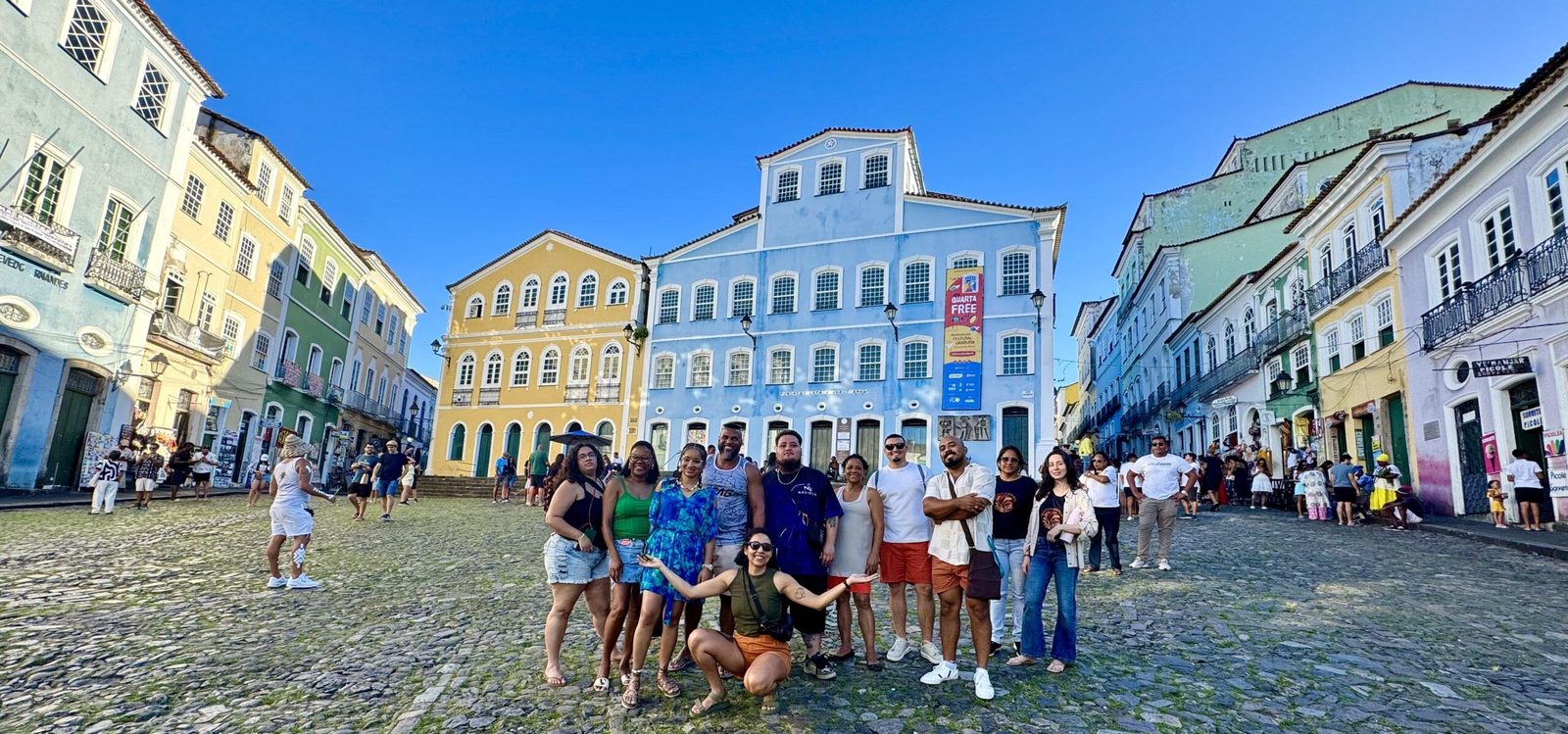
Inova Quebrada leaders at Pelourinho – Salvador.
The itinerary for Salvador included an immersion at Instituto Bantu, in Vera Cruz, and the staging of the first Inova Quebrada Forum. The forum featured Eduardo Santos, Executive Director of Instituto Salusvita, on ESG in peripheral organizations; Tâmara Regina, coordinator of IRSEBA, on building safe spaces for children in social projects; Rodrigo Coelho, co-founder of Nordeste Eu Sou (NES), in a dialogue on peripheral journalism and the representation of the periphery; and Mestre Roxinho, CEO of Instituto Bantu, who shared his knowledge on the pursuit of a possible organizational sustainability.
The Periphery as a Productive Space
In a setting where the scarcity of resources (whether material or symbolic) is often the lens that prevails when a territory is perceived, applying Survival Technologies is what makes things possible. This term, coined by Helena Rizzati (2020), holds that peripheral people—especially Black men and women, the essential hands that build and maintain the city through which capital flows—accumulate knowledge and technique, making it possible to apply and replicate that knowledge where access is insufficient.
The periphery as a productive space reproduces survival technologies through collective doing—that is, the socialization of different techniques and forms of knowledge that result in social impact at the scale of Place. Place, with a capital P, to delimit a living territory because, as Milton Santos (1996, p. 63) would say, “place is the framework of a pragmatic reference to the world,” and this can be seen in the concreteness of everyday relations, as at the Nkuta Bantu School Restaurant, where a Moqueca de Caju (cashew moqueca) was served to the Inova Quebrada participants. This dish was not merely a food alternative for minorities with dietary restrictions; it is the expression of cultural knowledge pushed further—creatively and innovatively converted—that brings economic impact: the ecosystem visited managed to cut costs on animal-protein purchases by drawing on what the territory has to offer.
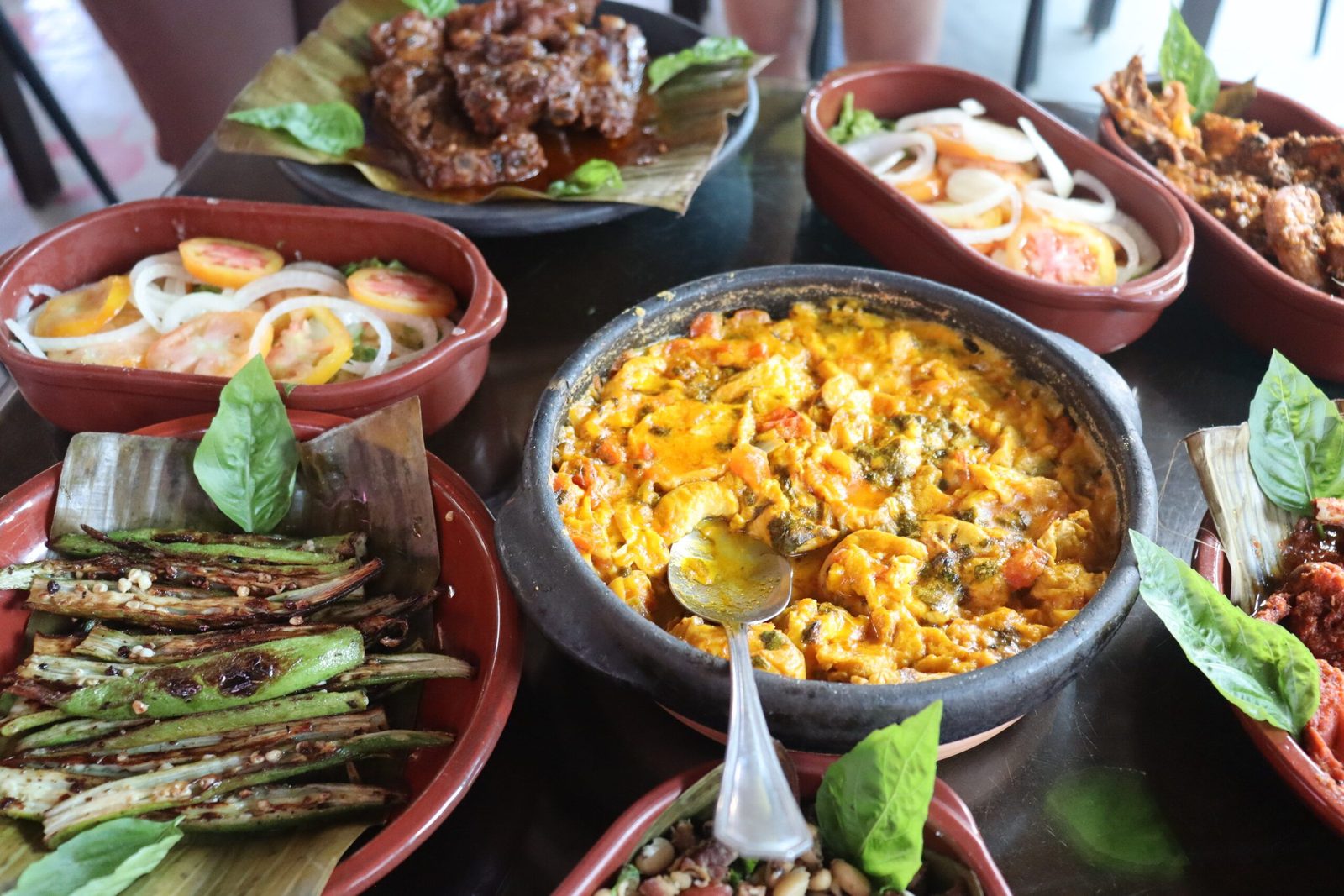
Moqueca de Caju served at the Nkuta Bantu School Restaurant. Photo: Suéllen Soares – Inova Quebrada Archive – Casa Hacker.
The actions that Instituto Bantu has recently promoted serve as an example of how survival technology is applied. But are we, as mobilizers of peripheral knowledge, walking a path that leads peripheral leaders to take ownership of and see themselves as producers, implementers, and holders of social technologies? It is from the pursuit of this understanding that the Inova Quebrada Forum presents itself as a space for exchanging the intellectual products created from the urban margins.
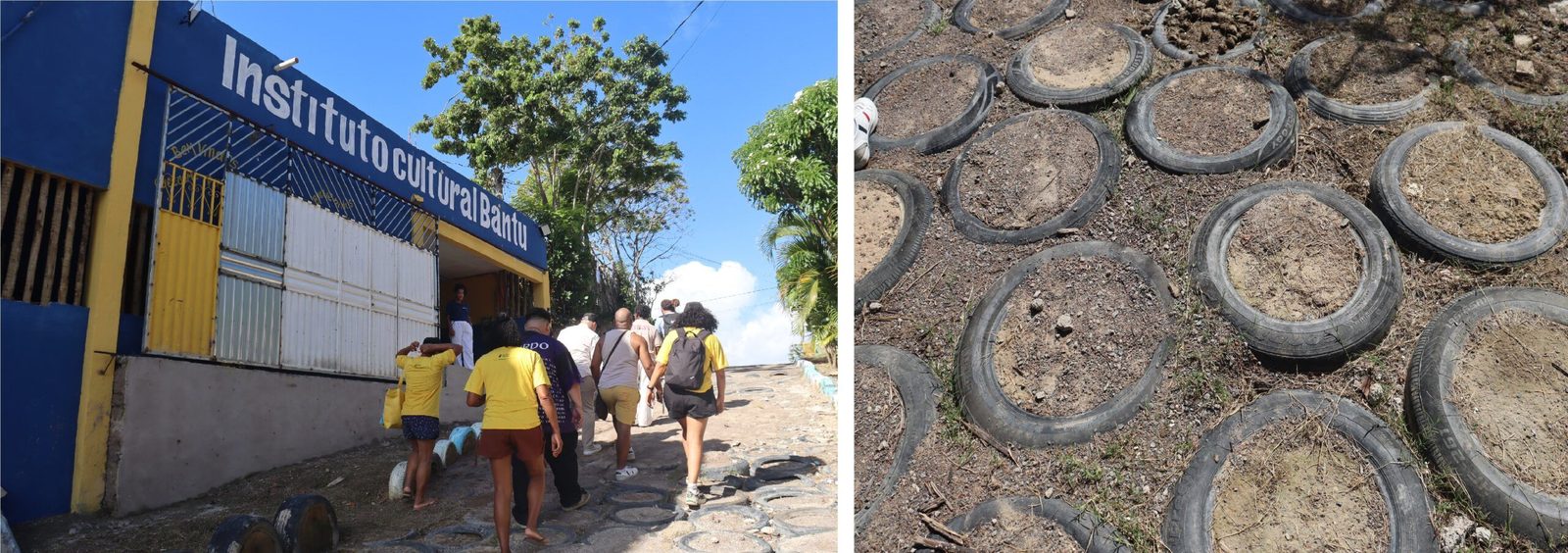
Itaparica’s first sustainable street: built with the community’s own labor through volunteering. Photo: Suéllen Soares – Inova Quebrada Archive – Casa Hacker.
Inova Quebrada Forum – Socializing Knowledge and Techniques
The way the traditional model of knowledge is currently produced has created a distance between what is considered valid and what is deemed unworthy of legitimacy; in this context, that relationship follows a logic in which knowledge from the center is recognized, while knowledge from the periphery has to speak much louder for much longer before it can, at some point, be taken into account. Until that happens, there is a whole body of accumulated knowledge that is still not validated as knowledge.
The Inova Quebrada Forum comes to gather, within a traditional system such as the university, the appreciation and socialization of knowledge, techniques, and lived experiences that can be translated as social, survival, and ancestral technologies. The forum did not propose individuality or talking about a product without sharing the recipe: the proposal was to bring the recipe and find ways to reorganize it so that, together, we can produce new products and new technologies because, as BITETTI (2019) says, “People can embrace the periphery as an existential place, where their knowledge and wisdom are at the service of life.”
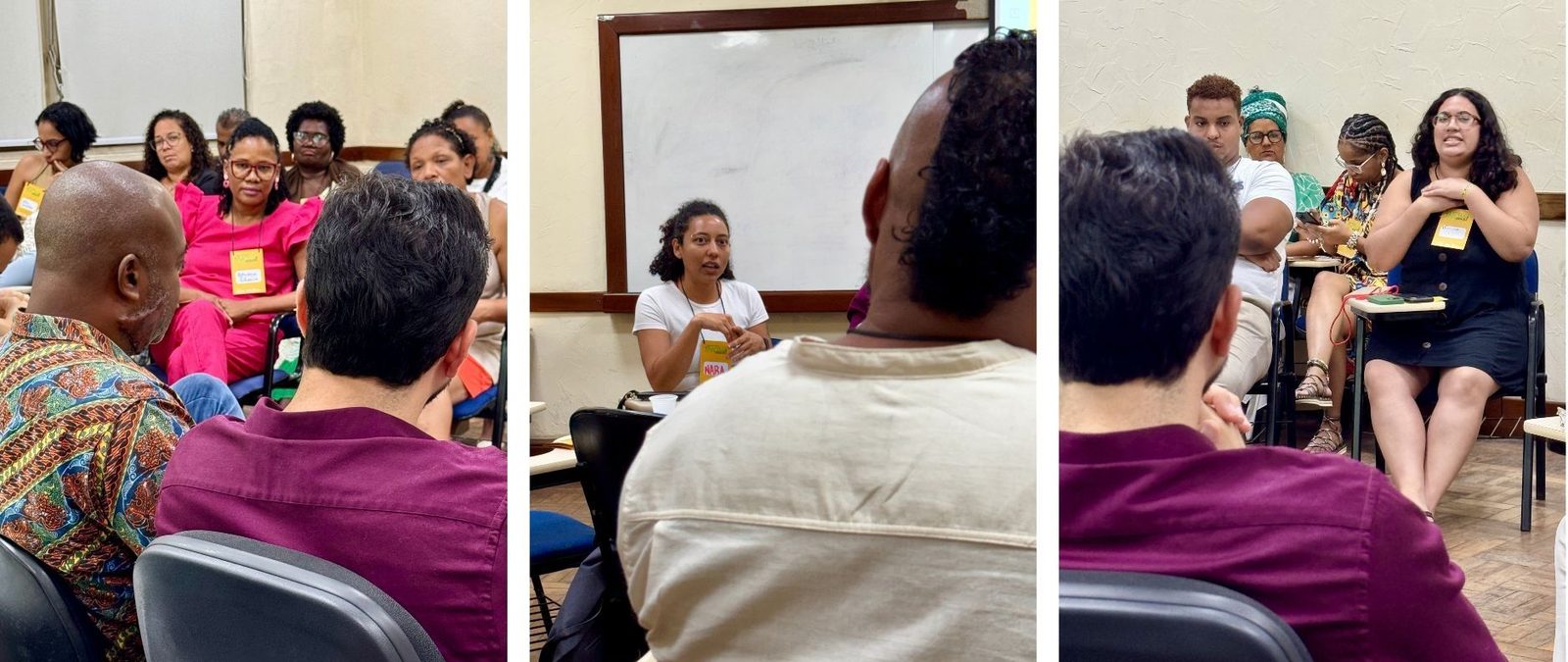
Moments of listening, debate, and sharing during the Inova Quebrada Forum. Photo: Orô Comunicação – Inova Quebrada Archive – Casa Hacker.
On the centenary of Milton Santos, at UFBA—where territorial thinking as we know it today was born—holding the 1st edition of Inova Quebrada is to transgress; it is to produce knowledge collectively instead of centralizing authorship; it is to call into the debate the more than 30 people who attended the 4-hour event and have them repeat, more than once, the African proverb that Mestre Roxinho made them promise to internalize: “Until the lions learn to tell their stories, the hunters will always be the protagonists of their hunts”—and there is nothing like the periphery to tell its own story.
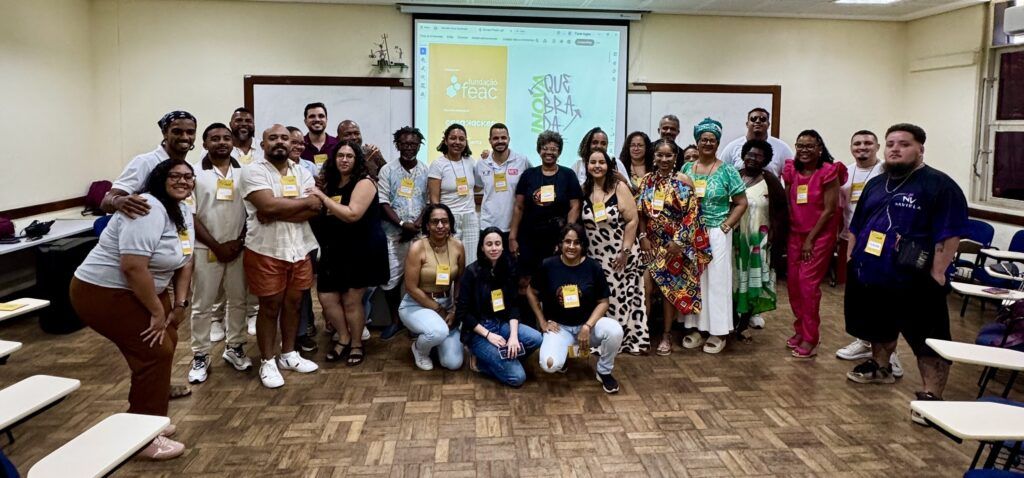
Closing of the 1st Inova Quebrada Forum – UFBA – Salvador. Photo: Orô Comunicação – Inova Quebrada Archive – Casa Hacker.
Bibliography
BITETI, Mariane; MORAES, Marcelo José Derzi. Vidas e saberes periféricos como potências transgressoras. Tlalli: Revista de Investigación en Geografía, Ciudad de México, ano 1, n. 2, p. 79-96, jul./dez. 2019.
CASA Hacker e Instituto Phomenta promovem fórum em Salvador para conectar lideranças periféricas e fortalecer redes de transformação social. Observatório do Terceiro Setor, [s.l.], [s.d.]. Disponível em:https://observatorio3setor.org.br/casa-hacker-e-instituto-phomenta-promovem-forum-em-salvador-para-conectar-liderancas-perifericas-e-fortalecer-redes-de-transformacao-social/.
INSTITUTO Cultural Bantu mobiliza mutirão para construir a primeira rua ecológica de Itaparica. Afro.TV, [s.l.], [s.d.]. Disponível em:https://www.afro.tv/blog/instituto-cultural-bantu-mobiliza-mutirao-para-construir-a-primeira-rua-ecologica-de-itaparica/.
PERIFERIA na UFBA: fórum em Salvador debate cozinhas solidárias, jornalismo de quebrada e soluções criadas nas comunidades. Correio 24 Horas, Salvador, 2026. Disponível em:https://www.correio24horas.com.br/salvador/periferia-na-ufba-forum-em-salvador-debate-cozinhas-solidarias-jornalismo-de-quebrada-e-solucoes-criadas-nas-comunidades-0526.
RIZZATTI, Helena. Tecnologia da sobrevivência: saberes e novos usos na ocupação Cidade Locomotiva em Ribeirão Preto/SP. PerCursos, Florianópolis, v. 23, n. 51, p. 105-135, jan./abr. 2022.
SANTOS, Milton. A Natureza do Espaço: Técnica e Tempo, Razão e Emoção. São Paulo: Hucitec, 1996.
*This article used artificial-intelligence tools exclusively to comply with ABNT formatting standards, without altering its content.
References
-
BITETI, Mariane; MORAES, Marcelo José Derzi. Vidas e saberes periféricos como potências transgressoras. Tlalli: Revista de Investigación en Geografía, Ciudad de México, ano 1, n. 2, p. 79-96, jul./dez. 2019.
-
CASA Hacker e Instituto Phomenta promovem fórum em Salvador para conectar lideranças periféricas e fortalecer redes de transformação social. Observatório do Terceiro Setor, [s.l.], [s.d.]. Disponível em: https://observatorio3setor.org.br/casa-hacker-e-instituto-phomenta-promovem-forum-em-salvador-para-conectar-liderancas-perifericas-e-fortalecer-redes-de-transformacao-social/.
-
INSTITUTO Cultural Bantu mobiliza mutirão para construir a primeira rua ecológica de Itaparica. Afro.TV, [s.l.], [s.d.]. Disponível em: https://www.afro.tv/blog/instituto-cultural-bantu-mobiliza-mutirao-para-construir-a-primeira-rua-ecologica-de-itaparica/.
-
PERIFERIA na UFBA: fórum em Salvador debate cozinhas solidárias, jornalismo de quebrada e soluções criadas nas comunidades. Correio 24 Horas, Salvador, 2026. Disponível em: https://www.correio24horas.com.br/salvador/periferia-na-ufba-forum-em-salvador-debate-cozinhas-solidarias-jornalismo-de-quebrada-e-solucoes-criadas-nas-comunidades-0526.
-
RIZZATTI, Helena. Tecnologia da sobrevivência: saberes e novos usos na ocupação Cidade Locomotiva em Ribeirão Preto/SP. PerCursos, Florianópolis, v. 23, n. 51, p. 105-135, jan./abr. 2022.
-
SANTOS, Milton. A Natureza do Espaço: Técnica e Tempo, Razão e Emoção. São Paulo: Hucitec, 1996.