It is nothing new that those who work in education, especially those on the front lines of classrooms and pedagogical spaces, know the challenges that the profession of educator faces. They include the lack of structure, low salaries, little recognition, students’ disinterest, and many other variables that keep arising while we are trying to apply our methodologies and practice our desire to share knowledge.
Educational contexts are very diverse: different types of schools, civil society organizations, cultural institutions, variations in the number of students, geographic, social, and political factors; all directly affecting how a class unfolds and how the dynamic between an educator and a student plays out. However, regardless of the school or institution, teaching is always a challenge and requires not only resourcefulness, flexibility, and willingness, but also people around us who help us keep going and do our work.
Books such as Pedagogia da Autonomia (1996) [Pedagogy of Autonomy] by Paulo Freire, Ensinando a transgredir: a educação como prática da liberdade (1994) [Teaching to Transgress: Education as the Practice of Freedom] by Bell Hooks, or Vence-demanda: educação e descolonização (2021) [Vence-demanda: education and decolonization] by Luiz Rufino, speak about the importance of sensitivity toward students, knowing how to contextualize them, drawing closer, and building a safe and welcoming pedagogical environment that makes you want to learn, just as it makes you want to teach. They also speak about how important it is to establish a dynamic exchange in which the educator/student roles are flexible and allow us, as teachers, to also grow and stay motivated.
But, faced with all the challenges that run through everyday educational life, how do we create an environment of belonging that makes sense both for us, educators, and for the students?
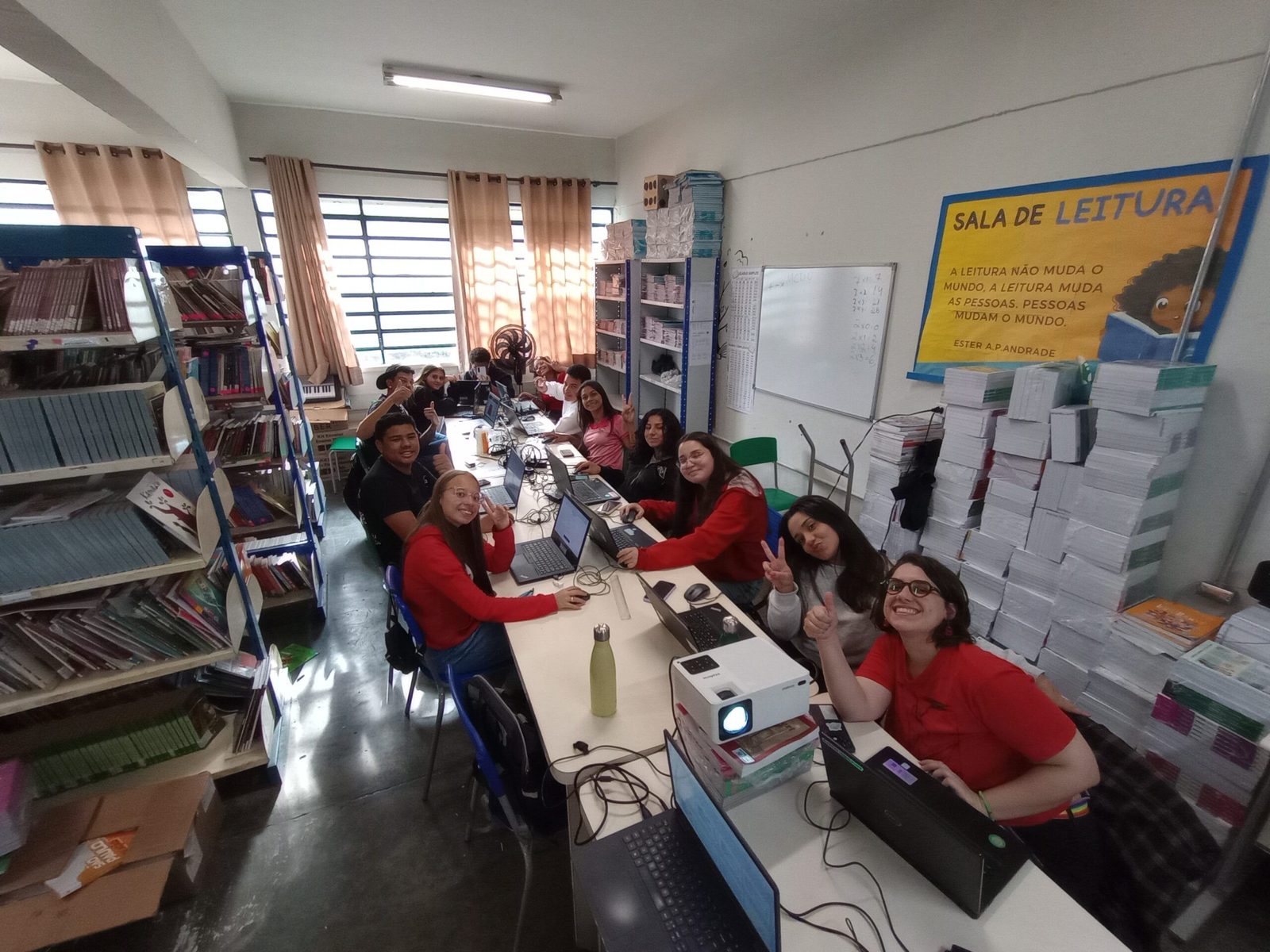
The HackerClubes Sumaré 2026 class in session with teacher Pamela Leite.
This is the kind of question that could come up in the teachers’ lounge while we have our coffee, at a bar table on a Friday after work, or even in a discussion during a teacher-training class at a university. And there is something very meaningful in these moments, because it is precisely by sharing this question that we begin, almost without realizing it, to build answers to it. It is through listening and exchange with other people who share similar contexts that we learn new strategies to carry on with our work, to work through the challenges that affect us, and to sustain our motivation. Being in a collective allows us not only to share experiences, but also to reframe events, review practices, and imagine other possibilities for teaching.
Shared teaching in practice
I say this not only as an observation backed by theory, but as something that runs through my own practice. I have worked in education for almost ten years and have been at Casa Hacker since 2024, and throughout this trajectory my guiding principle has always been to seek an education that makes sense for those involved in it, whether students or teachers. A concrete example of this is my experience teaching jointly with other teachers in Casa Hacker’s STEAM education projects: for a year and a half I worked alongside teacher Aliene Villaça with the students of the Minas em Tech project and, currently, I work together with teacher Pamela Leite in the HackerClubes class.
Both projects take place in public schools in the city of Sumaré, with classes of approximately twenty high school students. The classes are structured around the STEAM approach, integrating content related to science, technology, engineering, arts, and mathematics. Among the topics developed along the way are 3D modeling and printing, programming, electronics, artificial intelligence, and virtual reality. This knowledge is worked on in an interdisciplinary way through project-based learning, a methodology in which students develop their interests and skills and, at the end of the process, collectively create their own projects.
From the start, we seek to build with the students a different perspective on class, proposing an educational space in which learning happens through exchange, listening, and collective experimentation. More than transmitting technical content, the goal is to create an environment in which knowledge is built in a shared, light, and meaningful way. This dynamic is only sustained through the relationship of trust established with the students over the course of the process, but we also understand that this bond is directly shaped by the partnership built between us, the teachers.
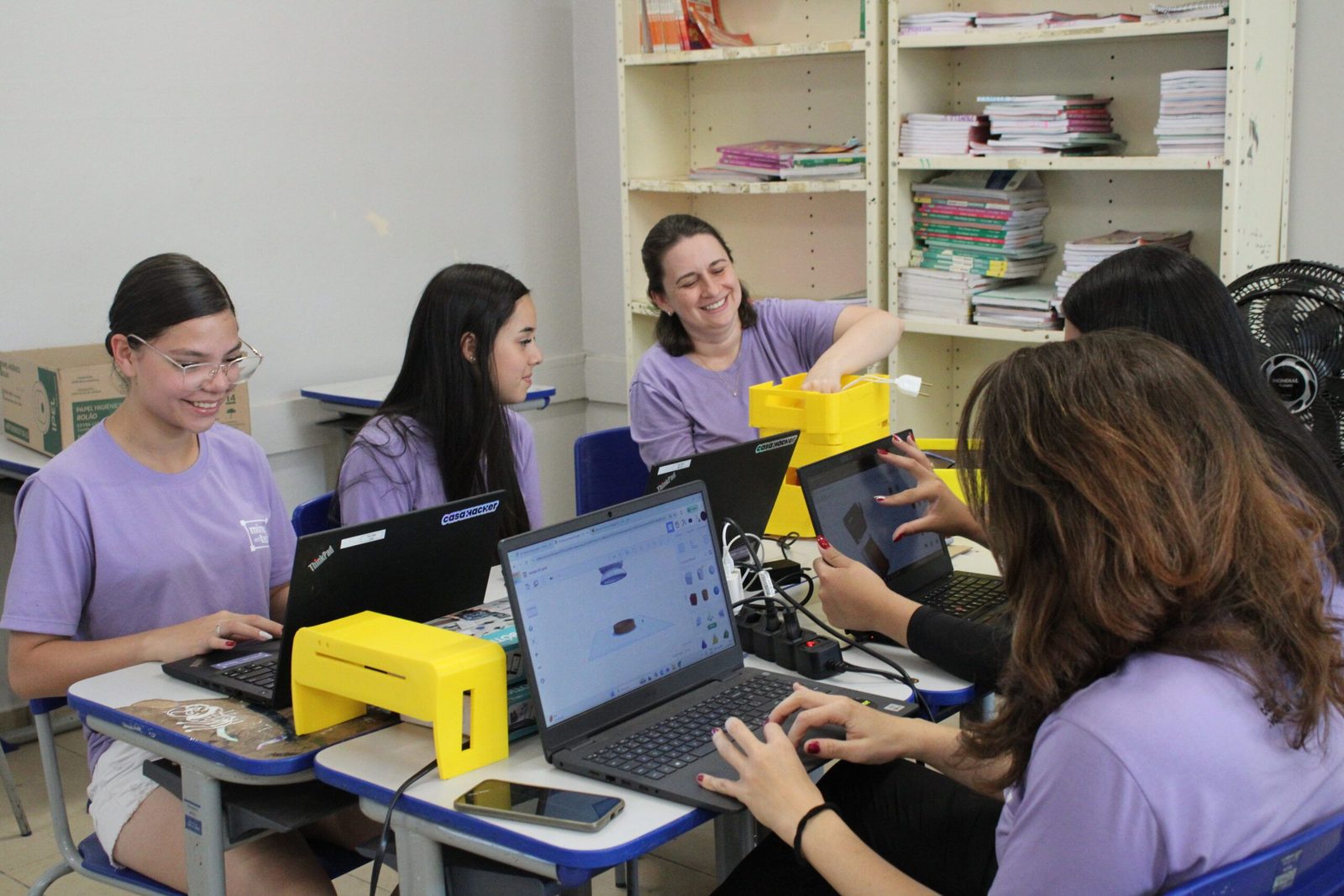
Teacher Aliene Villaça and her group of students assembling the final projects of the Minas em Tech 2025 class
The partnership between educators
The relationship between the educators is perceived by the students and directly influences the way they occupy this space. That is why we seek to build between us a horizontal relationship, based on dialogue, collaboration, and the recognition that none of us holds a more important place or is the exclusive owner of knowledge. It is natural that, at certain moments, one of us has greater technical command of a specific content, but this does not prevent planning from being collective, nor the facilitation of the class from being shared. In the same way, students are encouraged to relate to both of us, bringing questions, observations, and contributions without any centralization of speech or of knowledge.
The planning of the gatherings is also born from this exercise of collaboration. The meetings, the development of the content, and the organization of the activities are defined through agreements built between us, seeking to meet both the pedagogical needs of the course and the perceptions that each of us brings from the classroom. The planning is continuously adjusted based on the students’ engagement, on the need to revisit certain content, or on the openness to new proposals that arise along the way.
As a team, we maintain a constant practice of exchange about how the gatherings develop, sharing impressions about what worked, what can be reviewed, and how each activity resonated with the class. We share observations about the students, align expectations, and seek to build ways to welcome and encourage each participant. For this to happen, the communication between us needs to be clear, respectful, and shaped by listening. It is this continuous dialogue that makes it possible to align the classes and sustain the creative and learning environment we seek.
Beyond communication, another fundamental aspect is the sensitivity to know and recognize the person at our side. Understanding that life runs through work (that demands, tiredness, desires, and limitations extend beyond the space of the classroom) is an essential part of this process. Contextualizing the colleague you work with, respecting their limits and recognizing their ways of working, allows for the building of more caring and honest relationships. From this openness, the bonds of trust gradually grow stronger, transforming the professional partnership into an affective bond as well. And it is precisely in this meeting of collaboration, trust, and care that collective work becomes more powerful, effective, and rewarding.
Walking together
We know that creating environments of belonging in education is not an individual task. It requires structure, time, and decent working conditions that are still lacking for most educators in this country. But from my own experience, if it is possible for us not to work alone, things tend to become easier. The question of how to build spaces that make sense for those who teach and for those who learn does not have a direct answer, but the experience I have been having with what I have been calling shared teaching shows me that it begins to be answered when we choose to walk together. While we wait for the ideal conditions, which may take a very long time or may never come, it is in partnership, in listening, and in mutual care that we find strength and reasons to continue.
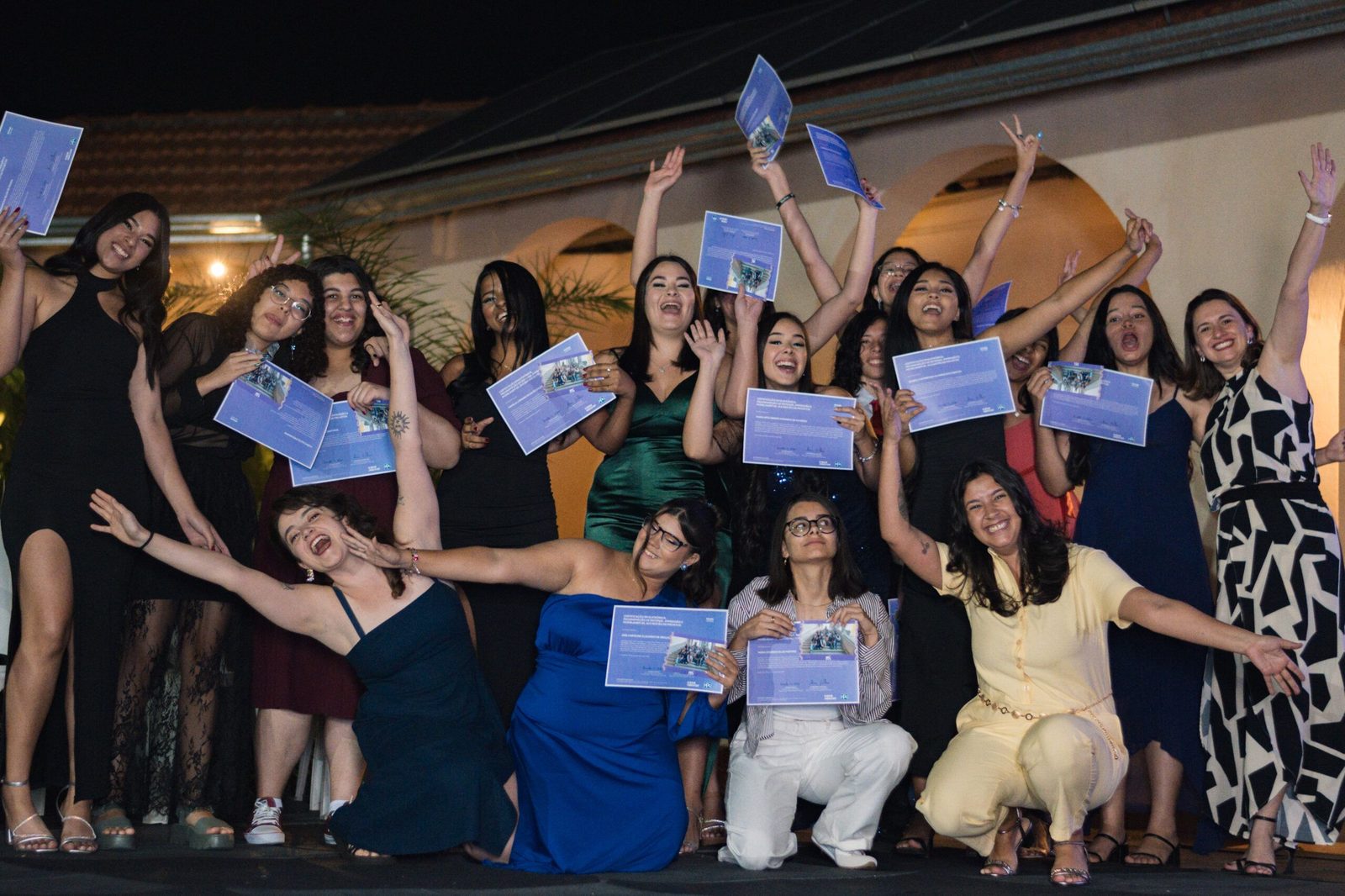
Celebration photo from the graduation of the Minas em Tech 2025 class. The image captures a bit of the joy of accompanying these girls throughout the whole year and of building this journey collectively, together with teacher Aliene Villaça and project manager Amanda, who, although she does not act directly as an educator, is also a fundamental piece in making everything happen.
FREIRE, Paulo. Pedagogia da autonomia: saberes necessários à prática educativa. São Paulo: Paz e Terra, 1996.
HOOKS, Bell. Ensinando a transgredir: a educação como prática da liberdade. São Paulo: Martins Fontes, 1994.
RUFINO, Luiz. Vence-demanda: educação e descolonização. Rio de Janeiro: Mórula, 2021.
References
-
FREIRE, Paulo. Pedagogia da autonomia: saberes necessários à prática educativa. São Paulo: Paz e Terra, 1996.
-
HOOKS, Bell. Ensinando a transgredir: a educação como prática da liberdade. São Paulo: Martins Fontes, 1994.
-
RUFINO, Luiz. Vence-demanda: educação e descolonização. Rio de Janeiro: Mórula, 2021.